
Reelhaus HQ: twelve AI agents that turn one recording into a ready to post video
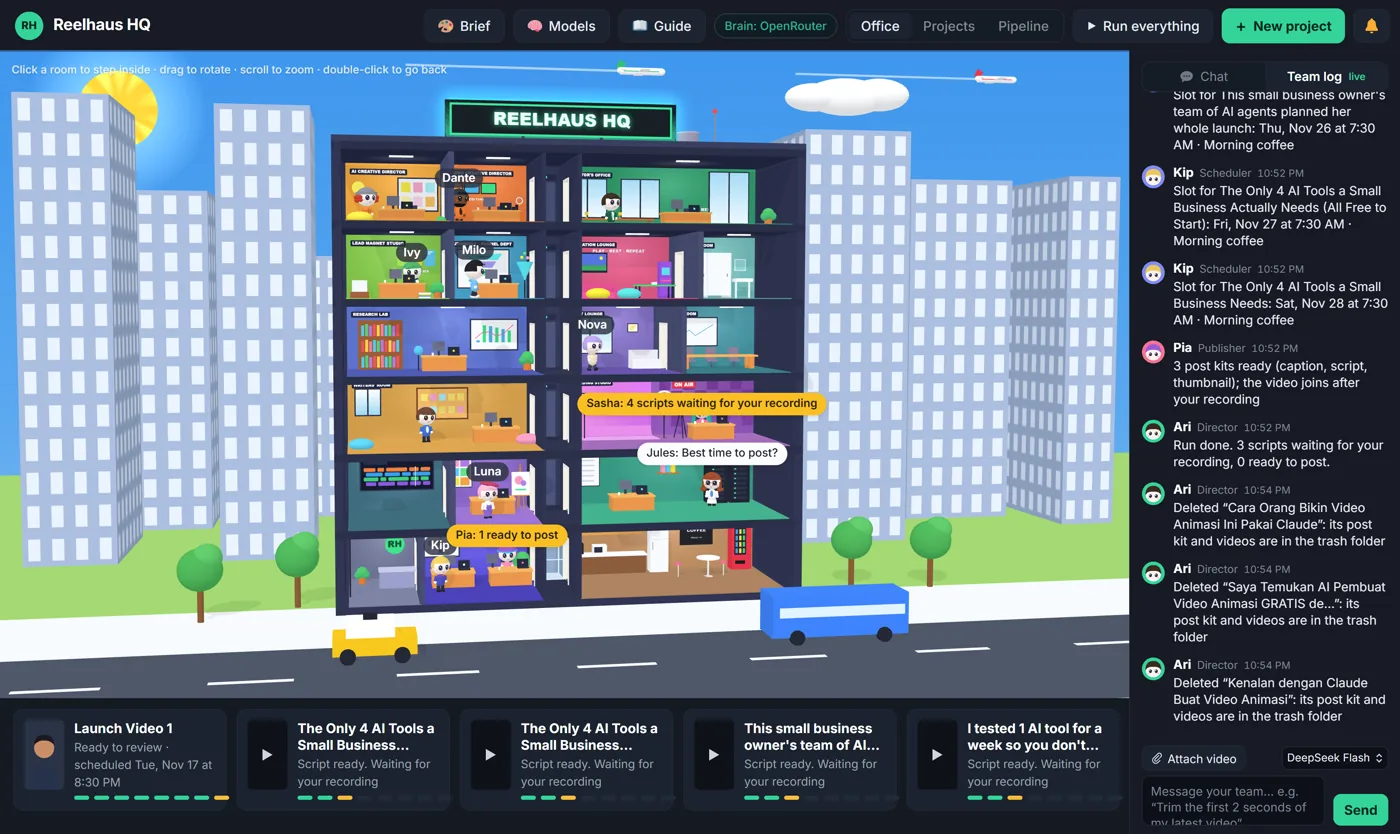
A short form video agency came to me with a problem of volume. Every account needs research, a script, a recording, an edit, captions, a thumbnail and a posting slot, every day. I built them a content team made of twelve AI agents, each with one job and its own model. You ask for a video, the agents research what is taking off in your niche, write your version of it, brief you, edit the take you record, pack the post kit and tell you when to post. The whole handover happens inside a 3D office you can watch, so you always know who is working and what is waiting for you.
Short form video agency (Europe)
Product designer and full stack engineer
3D office app, agent pipeline, local video toolchain, launch site
React 19, three.js, React Three Fiber, TypeScript, Tailwind CSS v4, Hono, Node, SQLite, Python, ffmpeg
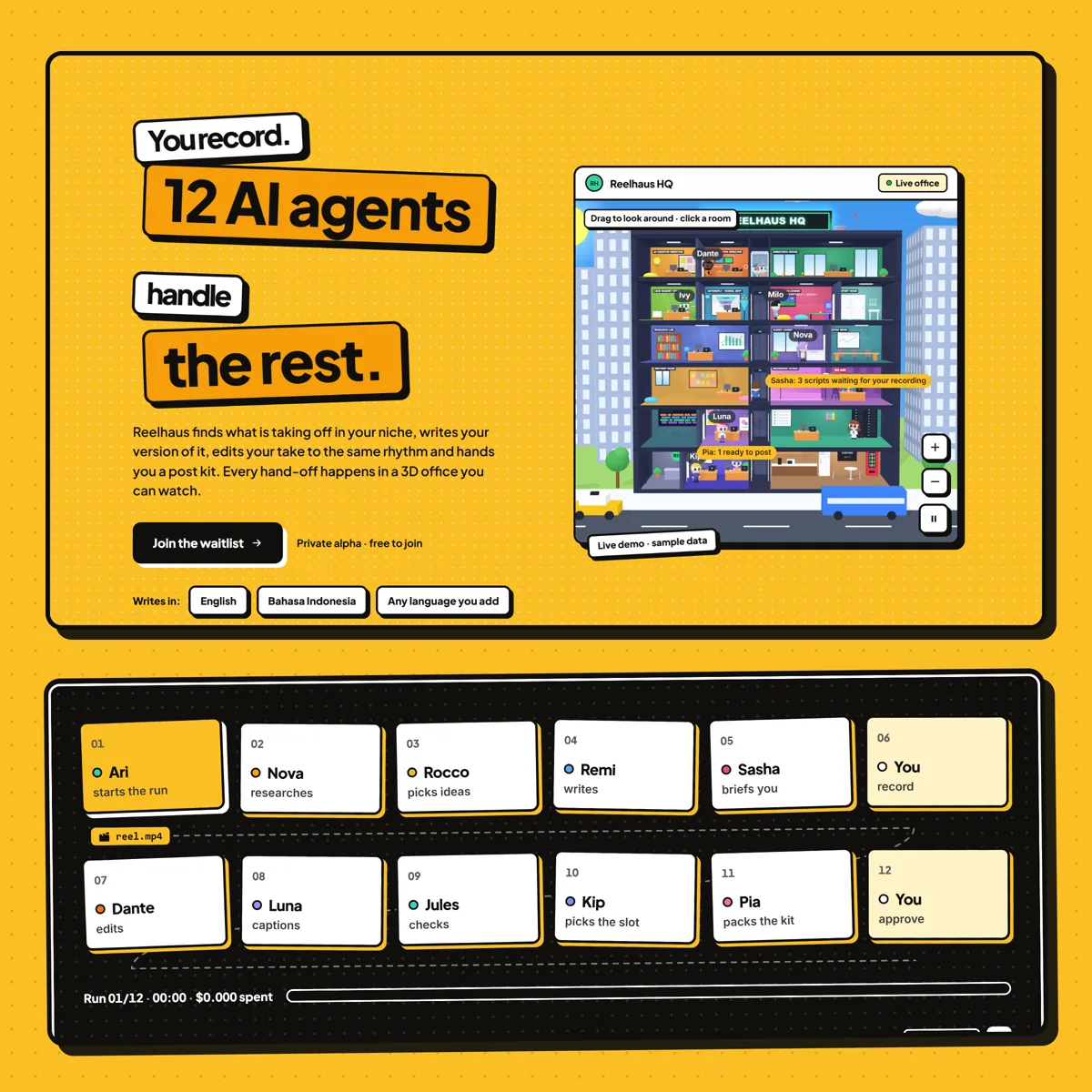
The office on that page is the real 3D scene from the product, not a video. Drag to look around, click a room to step inside, and watch a sample run pass from desk to desk. The product itself is in private alpha.
The problem
Short form video is a volume game. One video is easy. Thirty videos a month across several accounts, in more than one language, is a production line, and the person in front of the camera ends up doing everything behind it as well.
The usual answer is to buy six tools and glue them together: one for trends, one for scripts, one for editing, one for captions, one for scheduling, and a spreadsheet to keep track. Every handover between them is manual, nobody can see where a video is stuck, and the bill arrives from six directions.
So the brief was not "build an AI script writer". It was: take the whole run, from what is trending to a file I can post, and leave me with only the two jobs a machine cannot do, which are standing in front of the camera and saying yes.
Why a building, and not another dashboard
A pipeline of twelve AI agents has a real problem: you cannot see it. Work sits in a queue, something fails quietly, and the only way to find out is to read a log. Most tools answer that with a list of steps and a spinner, which tells you a lot about the system and nothing about your video.
I gave the pipeline a place instead. Every agent has a desk in a room on one of six floors. When Nova finishes researching and hands the work to Rocco, you watch her walk out of the Research Lab, take the glass lift and deliver it. A status bubble over a desk tells you who is working, and an amber bubble tells you who is waiting for you. One glance replaces a status page.
It also solves something quieter. People do not trust a black box that spends their money. Watching the work move makes the thing legible, and a tool you can read is a tool you keep using.
What I built
-
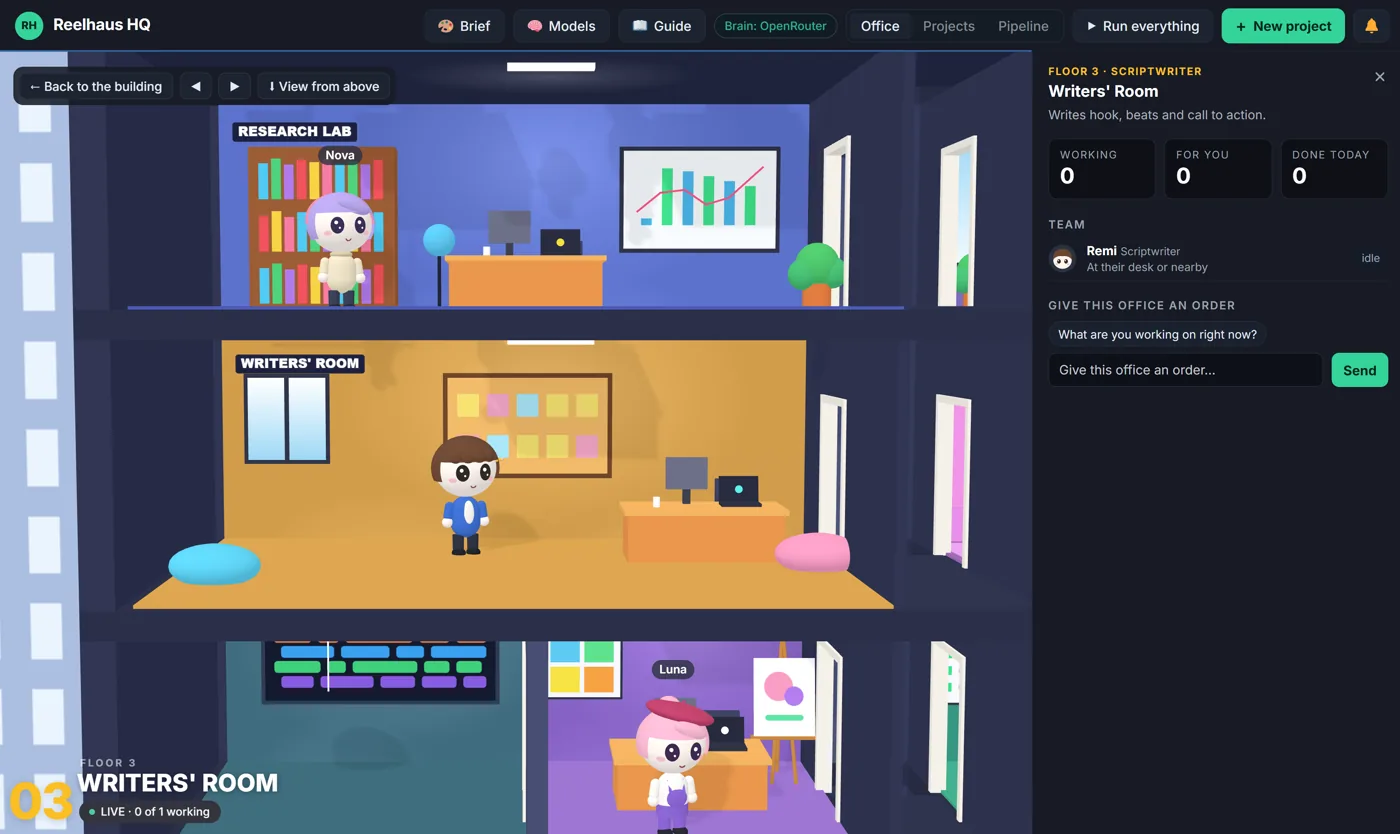
A 3D office you can walk into. A cutaway building of six floors and eighteen rooms, with a city around it. Drag to look around, click a room to fly in and give that department an order, click a character to see what they are working on.
-
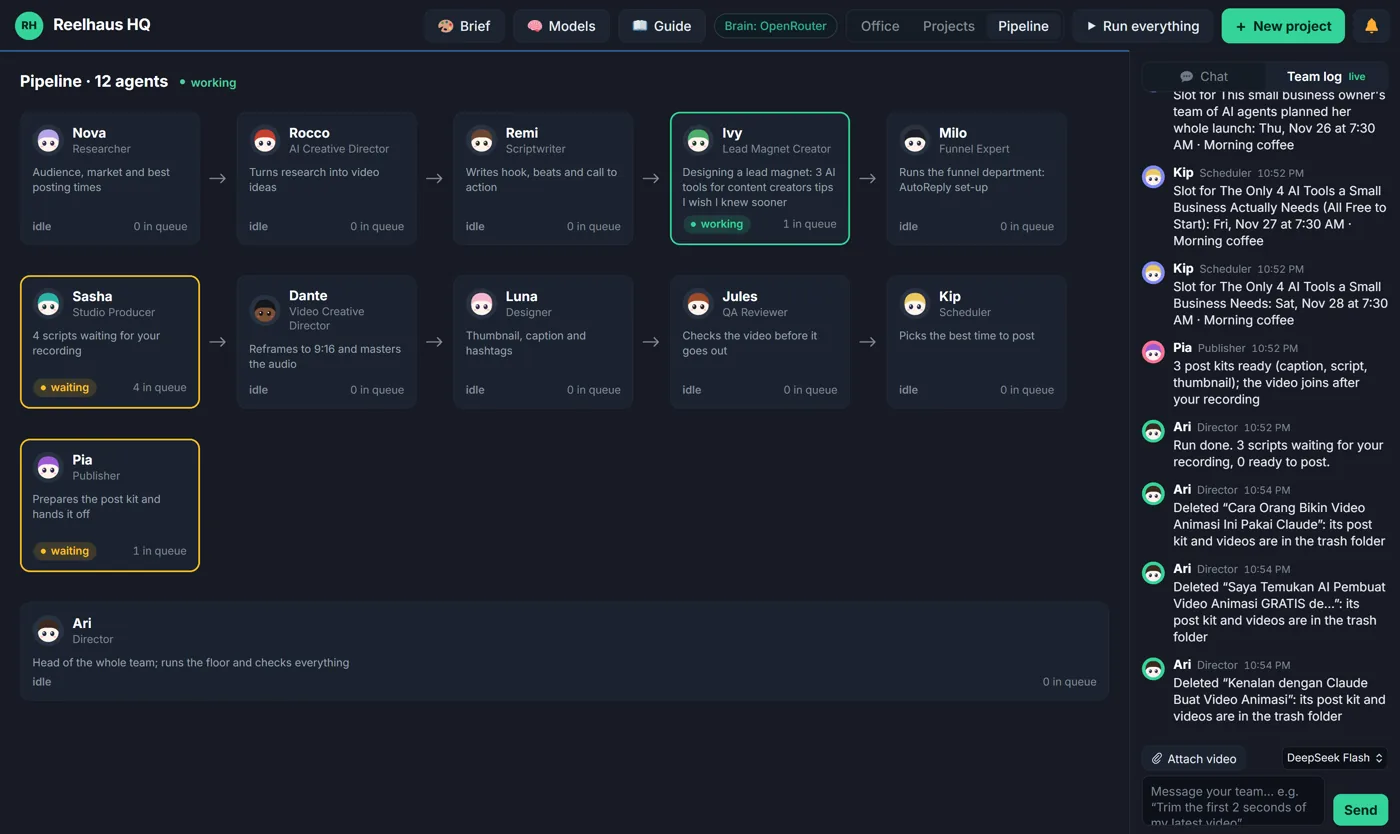
Twelve agents with one job each. A researcher, a creative director, a scriptwriter, a studio producer, a video director, a designer, a QA reviewer, a scheduler, a publisher, a lead magnet writer, a funnel specialist and the director who starts the run. Each one runs on the model that suits its job.
-
Research that looks at what is working now. Rising videos are pulled with yt-dlp and a logged out browser, ranked by views per day, and turned into a pattern card: the hook, the beats, the call to action, the caption format and the hashtags. Scripts are rebuilt on that pattern at a similarity band you set, so your version is close enough to work and far enough to be yours.
-
Editing that copies the rhythm, not the content. A viral short is broken down into an edit template: cut rhythm, punch ins, framing, caption style and music beat. That template is then applied to the take you recorded, with ffmpeg doing the work on your own machine.
-
A post kit, not a pile of files. Every run ends in one folder: the finished video, the caption, the hashtags, the thumbnail and the posting slot, with links straight to the upload pages. Accounts can each have their own language, audience, time zone and niche.
How a run works
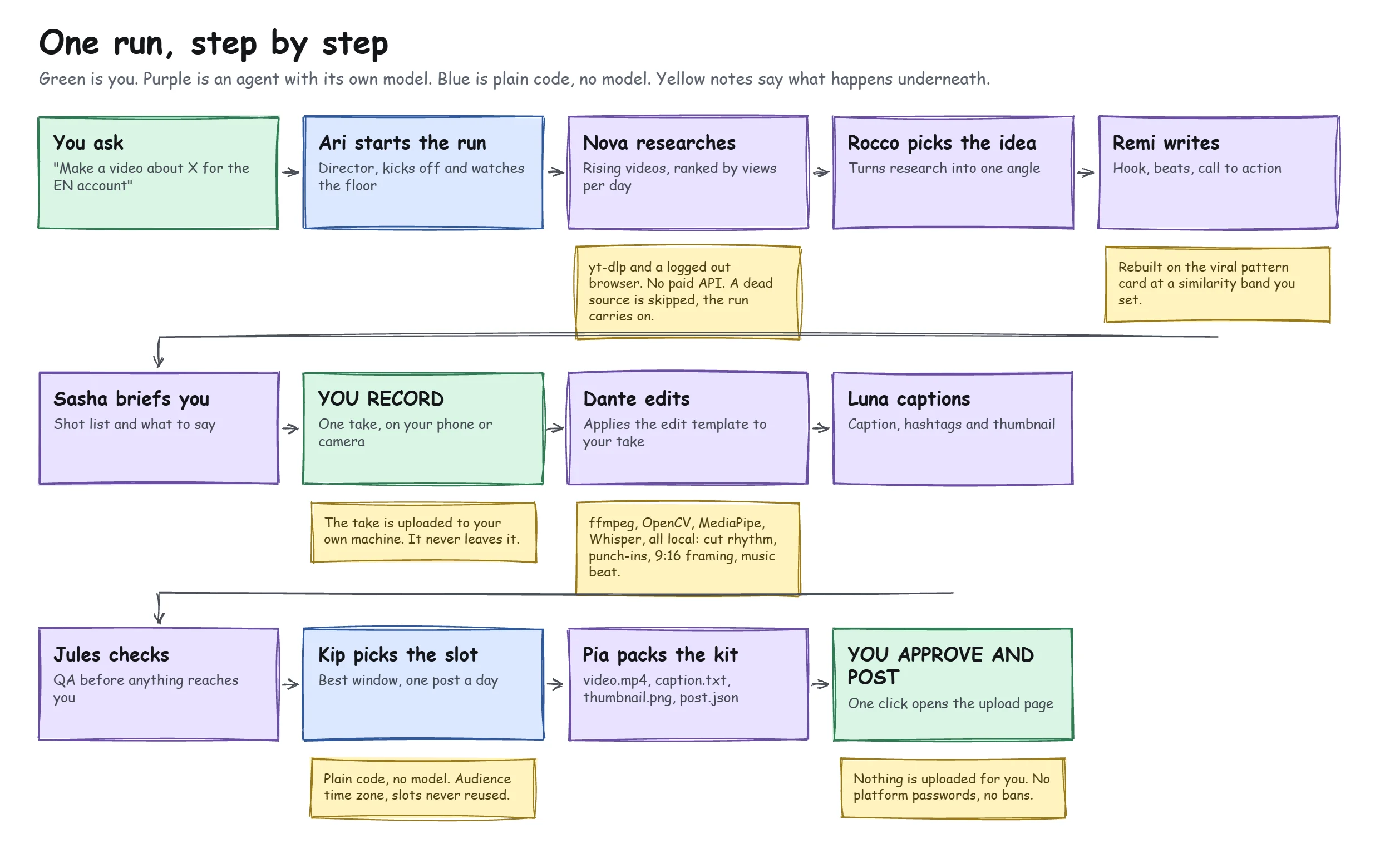
One run is twelve steps, and it stops twice for you. Step six is your recording, step twelve is your approval. Everything in between happens on its own, and you can watch it move.
The stack
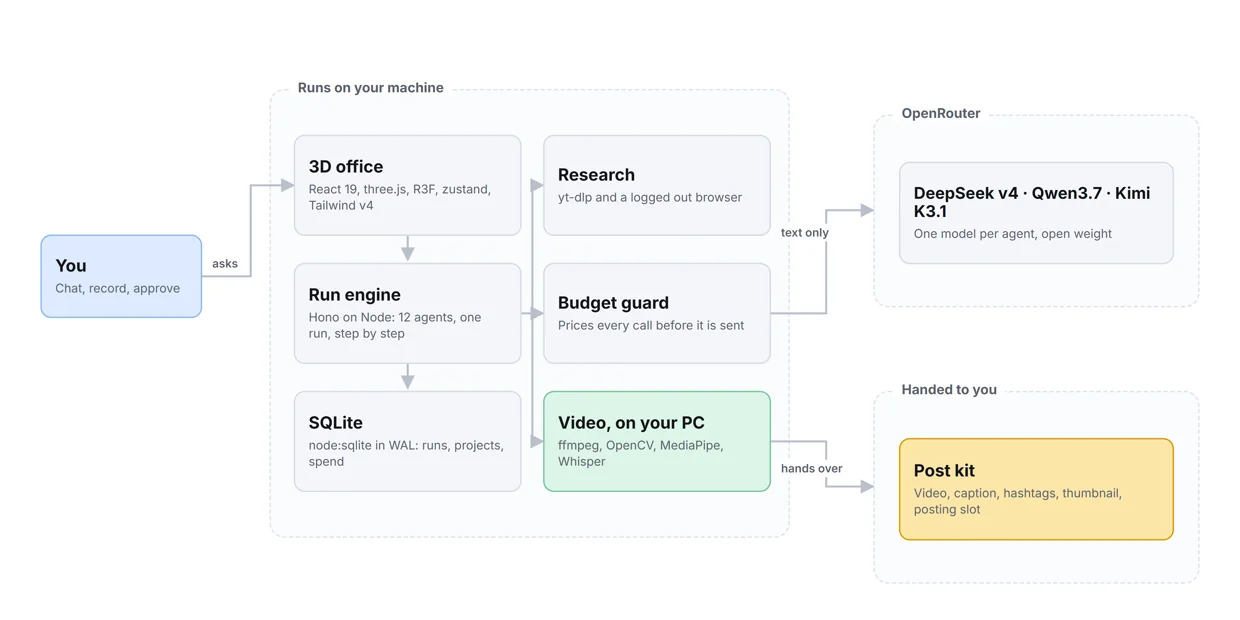
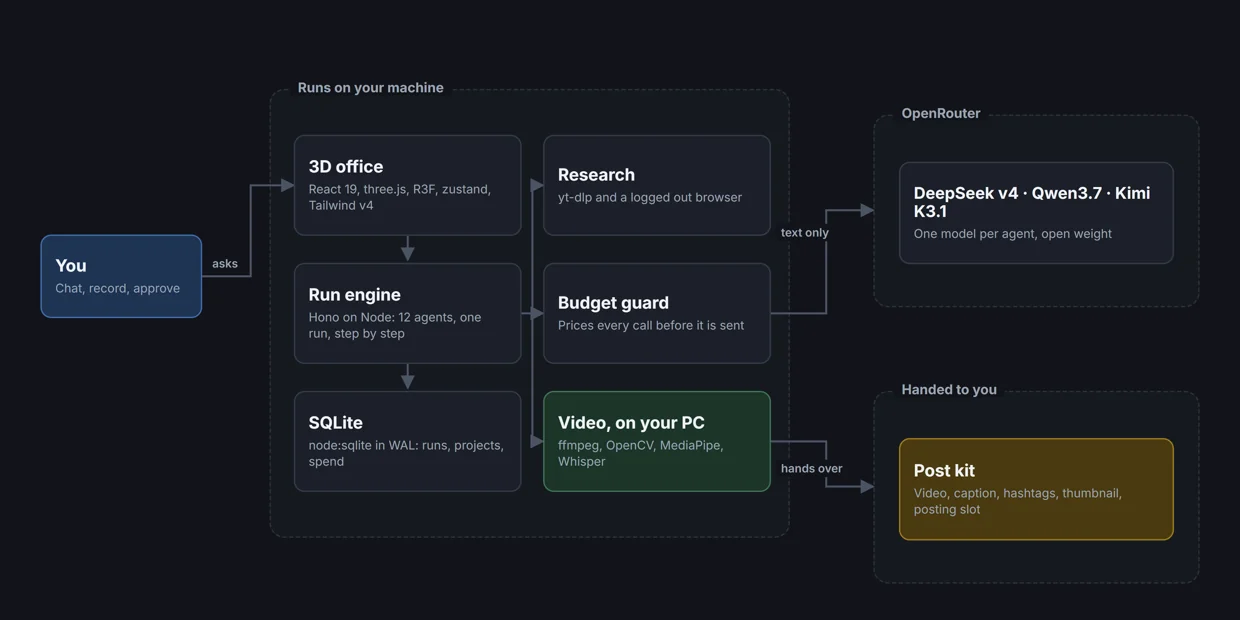
The office is React and three.js through React Three Fiber, driven by one store, so the same scene can be dropped into the launch site without rebuilding it. Behind it a small Hono server on Node runs the agents, keeps every run in SQLite and calls the models through OpenRouter. The video work never goes near a server: it runs on your own machine in Python with ffmpeg, OpenCV, MediaPipe and Whisper.
Everything that is in it
React 19, TypeScript, Vite 6 and Tailwind CSS v4.
three.js with React Three Fiber and drei. Characters and furniture are built from primitives in code, with no imported models.
zustand, in one store that the product and the launch site both read.
Hono on Node, pushing every change to the office over server sent events.
SQLite through the built in node:sqlite in WAL mode, so there is no native build step to go wrong on a client machine.
OpenRouter: DeepSeek v4 Pro and v4.1 Flash, Qwen3.7 Plus and Flash, Kimi K3.1 Pro. Each agent names its model in config.
yt-dlp, a logged out browser and a community signal engine, cached per topic and country.
Python with ffmpeg, OpenCV, MediaPipe and Whisper, split into modules for cuts, framing, motion, zoom, music, speech, subtitles and render.
An HTML template rendered to PNG through headless Chrome, on the same machine.
The same React and three.js scene, imported through one alias instead of copied, and loaded lazily over a video poster.
How the 3D office actually works
The office is not a video and not a decoration. It is a view of what the server is doing, and it had to run on a laptop while twelve agents work.
-
Built from code, not from a model pack. The building is laid out in world units where one floor equals one unit, and every character is assembled from a few primitives. Nothing is downloaded as a mesh, so the whole office ships as part of the bundle and starts instantly.
-
Materials and labels are made once and shared. Every colour has one matte material cached and reused, and the room name tags are drawn once onto canvas textures rather than being eighteen separate text meshes. That is what keeps a building this busy cheap to draw.
-
Movement lives outside React. Walking is a per frame state machine that components read each frame, so a character crossing a floor never triggers a React render. Each character queues its trips rather than overlapping them: a hand-off walk, a room order, or a trip between their desk and where they idle.
-
Hand-offs are real, including the lift. When work passes from one agent to another on a different floor, they walk to the core, ride the glass lift, two at a time, deliver the work with a bubble and walk back. What you are watching is the pipeline moving, not a loop on a timer.
-
The building stays alive between runs. Idle agents take short outings to the pantry, the lounge or the screening room, and two of them will stop and talk. All of it is client side, and any outing is cut short the moment that agent has real work.
What arrives at the end, and why nothing is posted for you
A run ends in a folder. Kip picks the posting slot with plain code and no model at all: the best window for that audience in their own time zone, one post per day, and a slot that has been handed out is never reused. Pia then writes the kit next to it: the edited video.mp4, caption.txt, script.md, a thumbnail.png rendered locally from an HTML template through headless Chrome, and a post.json with everything in machine readable form.
Then it stops. Nothing is uploaded anywhere: the kit opens the upload page for the platform you want and you post it yourself. That is deliberate. Posting on your behalf means holding your platform passwords or tokens, and automated uploads are exactly what gets creator accounts limited. The whole point of the product is to remove the hours, not to gamble the account, and the cost of that choice is one click.
One small thing that matters in daily use: if you edit the caption by hand and the run refreshes the kit, your version survives. The kit keeps a hash of what Pia last wrote, so it only replaces what it still owns.
The hard parts, and how I solved them
Wiring twelve agents together is the easy half. The work is in the money, the footage and the machines this has to run on.
-
Spend that cannot run away. An agent loop that goes wrong is a bill, and the owner finds out the next morning. So every call is priced before it is sent and checked against two caps, one for the whole install and one for a single run. The part that matters is what happens when several agents call at once: each call holds its worst case until its real usage is recorded, so two calls can never both pass the same check on the same remaining balance. The run stops instead of overspending.
-
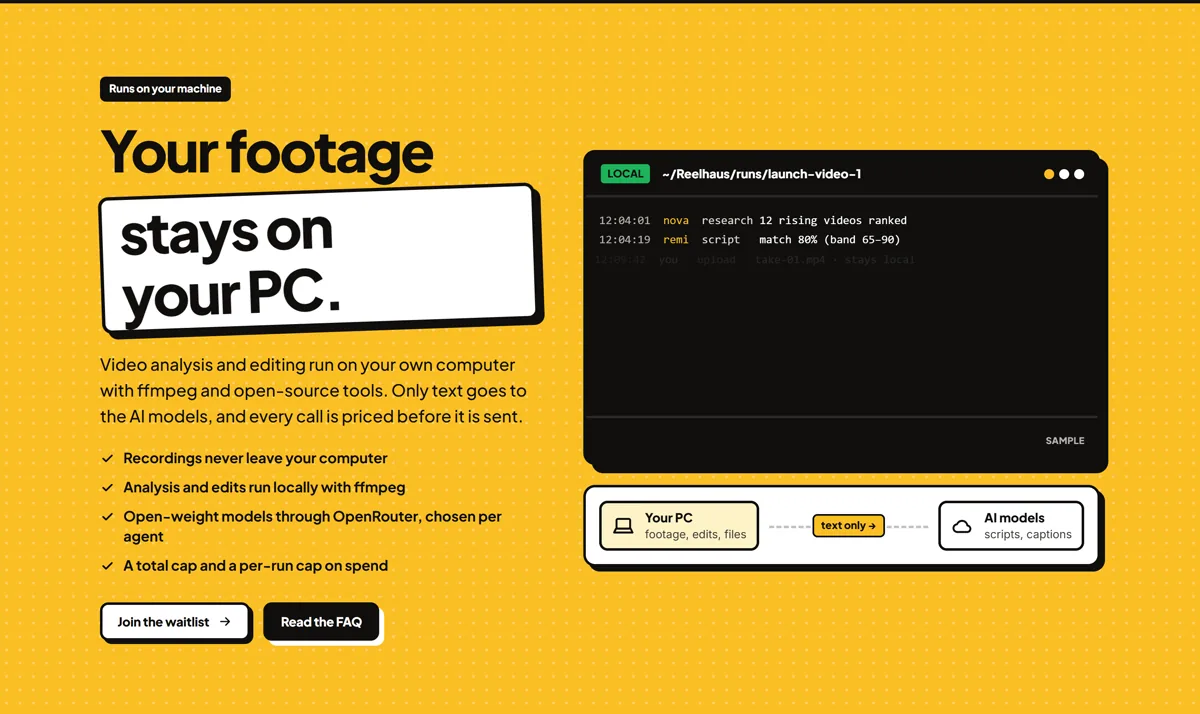
Footage that never leaves the building. Agencies hold client footage they are not allowed to upload anywhere, which rules out most AI editing tools. Here the analysis and the edit run locally in Python, and only text ever reaches a model: the script, the caption, the idea. Raw takes stay on the machine they were recorded on, which is also why the whole thing costs so little to run.
-
Trend research without paid APIs. Social platforms either charge for their data or do not sell it at all. Research is pulled instead from public sources with yt-dlp and a logged out browser, cached per topic and country so the same question does not fetch twice, and if a source goes down the run skips it, notes it and carries on with the rest. Research that stops the entire pipeline because one site changed its markup is not research.
-
A 3D office that still opens on a weak laptop. A building full of animated characters is a lot to ask of a four year old machine, and the launch site cannot afford to show a blank box to a visitor. The site opens on a video poster and loads the real scene behind it, then cross fades once it is ready. If the device is weak, WebGL is missing or the visitor asked for reduced motion, the video simply stays. Nobody gets a broken page, and nobody waits for a download they did not ask for.
-
One account in English, the next in another language. Research and output are separated on purpose. An account can study what is going viral in one country and publish in a completely different language, with its own audience, time zone and niche. That split is what lets one person run several accounts without writing everything twice.
How I write the code
-
One agent, one file, one job. Research, scripts, remakes, production, QA, scheduling and publishing each live in their own module on the server, so a change to how scripts are written cannot break how videos are cut.
-
The model is a setting, not a decision baked into the code. Each agent names the model it wants in config, so a cheaper or better model can be swapped in without touching the pipeline.
-
Typed from end to end. Strict TypeScript across the app, the server and the site, with the 3D scene shared between the product and the launch site through one alias instead of a copy that quietly drifts.
-
Failures are expected, not exceptional. A source that goes down, a model that returns nonsense and a video file that will not open are all normal days. Each one is caught where it happens, written to the run log and shown in the office, rather than ending the run.
Delivery
The product is in private alpha and opening through a waitlist, so what is public today is the launch site. It is worth a look for one reason: the office on it is the real scene from the app, served lazily and driven by the app's own store, so a visitor gets to use the product before being asked for an email.
What ships is the repo, the server, the Python video toolchain and the setup guide, with the models configured per agent and the spend caps already in place.
What you get when you work with me
-
A product, not a prompt. Interface, pipeline, storage, cost control and delivery, built to work together from the first day.
-
AI spend you can predict. Every call priced before it is sent, caps you set, and a record of what each run cost.
-
Your files stay yours. Heavy media work runs locally by design, so client footage never has to be uploaded to a third party.
-
An interface people want to open. I design the thing as well as build it, so the product does not arrive as a wall of forms.
What the client got
12
Agents in one run, each with its own job and model
2
Steps that still need you: record and approve
5
Open weight models, picked per agent and swappable
Years of
Experience
Projects
Delivered
Features
In Production
Community
Members
Get in touch
Have a product to build, or a workflow that eats your team's time? Tell me about it.I'll build a small working piece of it first, free, so you can judge the result before you commit.