
Ilmora: a course marketplace where students learn, instructors get paid and admins stay in control
An online education company in Dubai needed a learning platform where many instructors sell their own courses. Students buy, learn at their own pace, pass a quiz and get a certificate anyone can verify. Instructors build courses and get paid for every sale. Admins approve what goes live and keep the money straight. I built it in Laravel and React as three panels on one platform, and Ilmora is the public demo of it that you can click through yourself.
Online education company (Dubai, United Arab Emirates)
Full stack engineer
Student, instructor and admin panels, payments, certificates
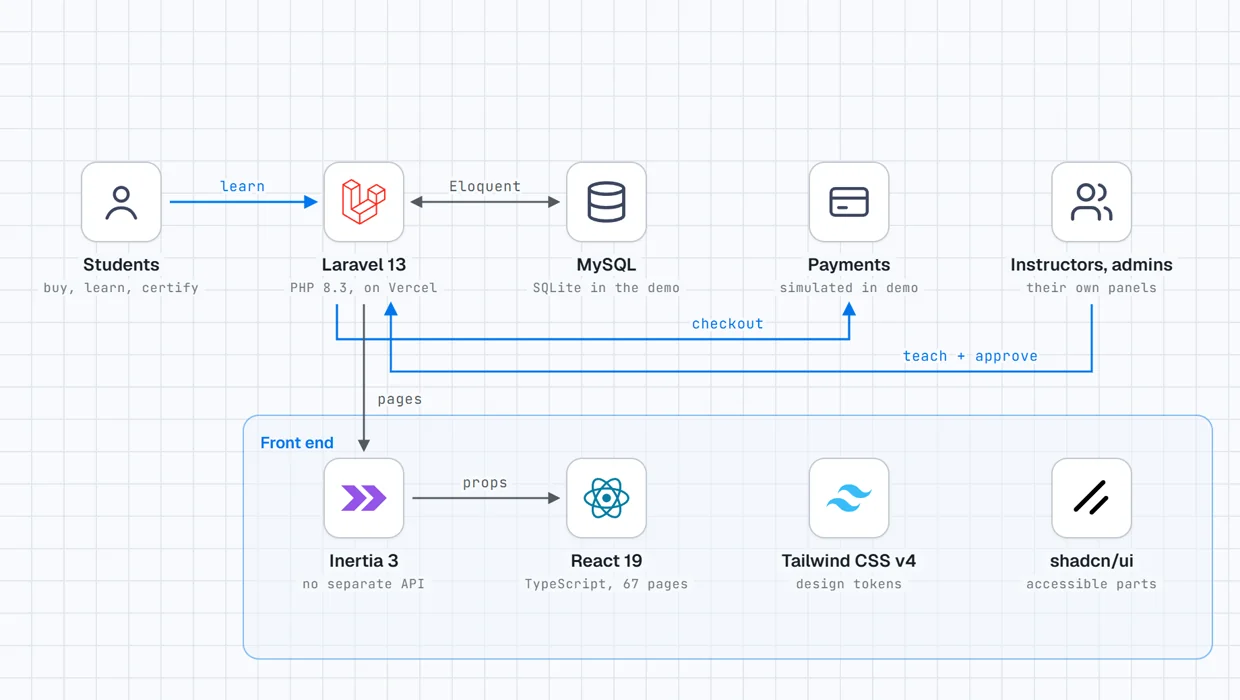
Laravel 13, PHP 8.3, Inertia, React 19, TypeScript, Tailwind CSS v4, shadcn/ui, MySQL
On the login page, pick a student, an instructor or an admin and you're in with one click. Or sign in yourself with one of these demo accounts, all with the password password:
- Admin:admin@ilmora.test
- Instructor:sarah@ilmora.test
- Student:nadia@ilmora.test
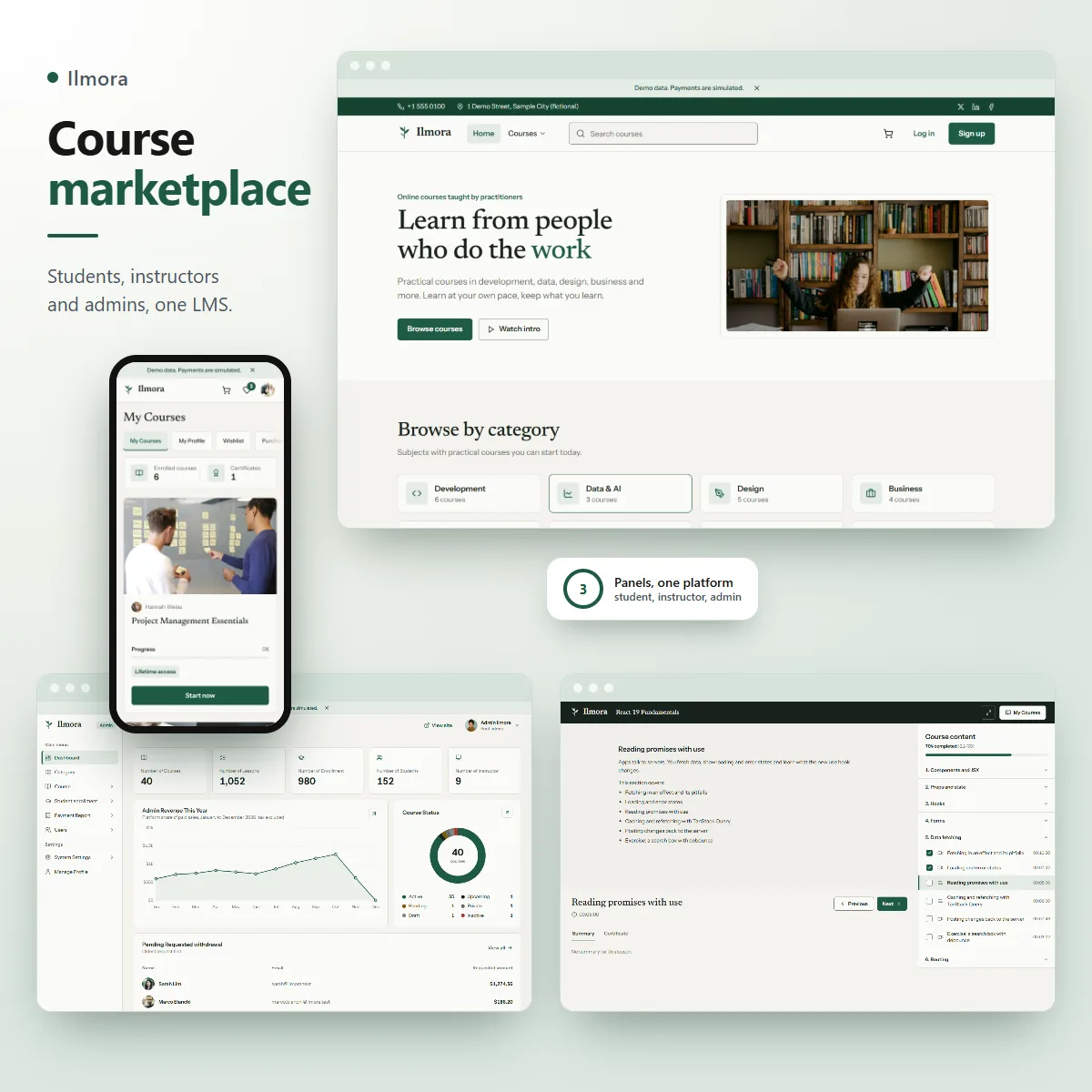
Why you're looking at a demo
The platform I built for the client is covered by a confidentiality agreement, so I can't show it, its courses, its users or even its name. Ilmora is a demo I put together to present the same flows instead: a student buying and finishing a course, an instructor publishing and getting paid, and an admin running the whole thing.
Everything works, but the courses, people, reviews and numbers are sample data, and payments are simulated. So you can buy a course, take the quiz and approve a payout without spending anything or touching anyone's real data.
The problem
A course marketplace is three products sharing one database. Students want to find a course, pay without friction and pick up exactly where they stopped. Instructors want to build a course without a developer and see what they've earned. The business wants to check every course before it goes live, take its share of every sale, and pay instructors on time.
If any one of those breaks, the others feel it. A wrong split means an angry instructor. A lost progress bar means an angry student. A course that goes live unchecked is a problem for the business.
What I built
-
A storefront students can browse. A catalog with categories and filters for price, level, language and rating, course pages with the full curriculum, reviews and instructor profiles, a wishlist and a cart with coupons.
-
A player that remembers where you were. Video, reading and quiz lessons in one place, with progress saved lesson by lesson, so a student can stop on a laptop and carry on from their phone.
-
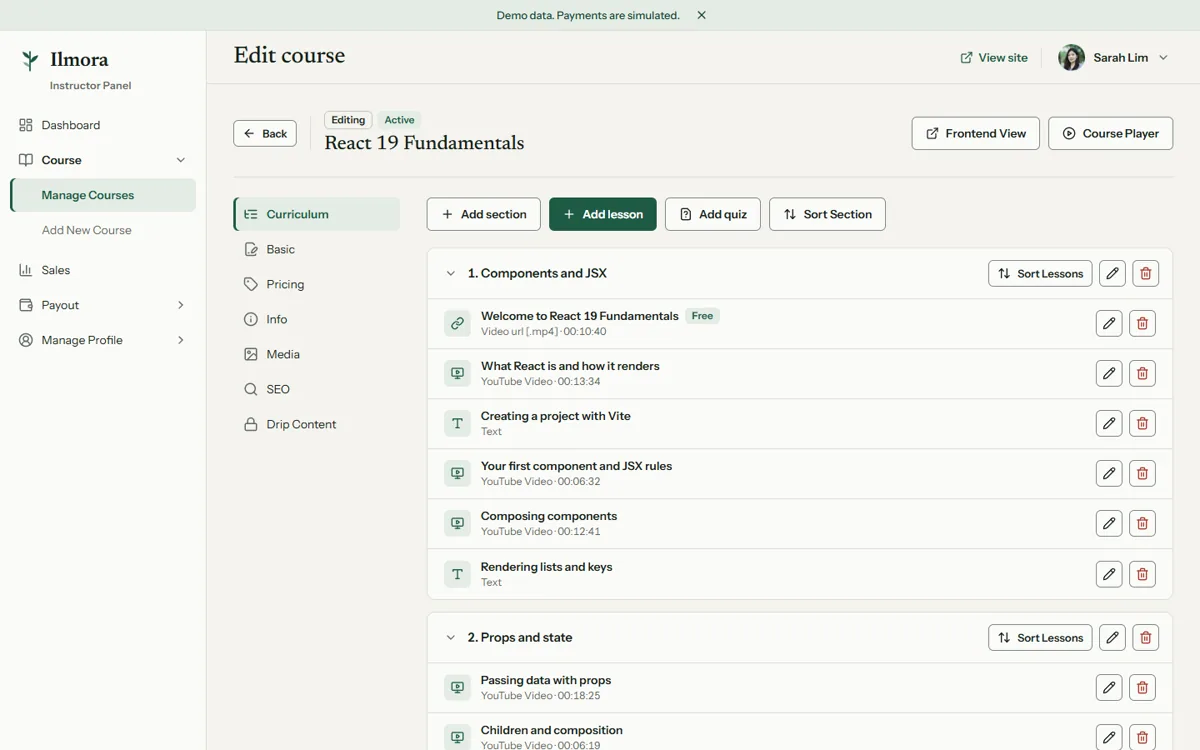
A course builder for instructors. Sections, lessons and quizzes, reordered by dragging, with pricing, media, SEO and drip release in their own tabs. A lesson can be a YouTube or Vimeo video, an uploaded video or a video link, a Google Drive file, a document, text, an image, an embed or a quiz.
-
An admin panel that runs the business. Course approval, categories, coupons, manual enrolments, revenue reports, payment history, instructor payouts, instructor applications and a drag and drop certificate designer.
-
Certificates anyone can check. Finish every lesson and download a PDF certificate with a public link, so an employer can confirm it's real.
How it works
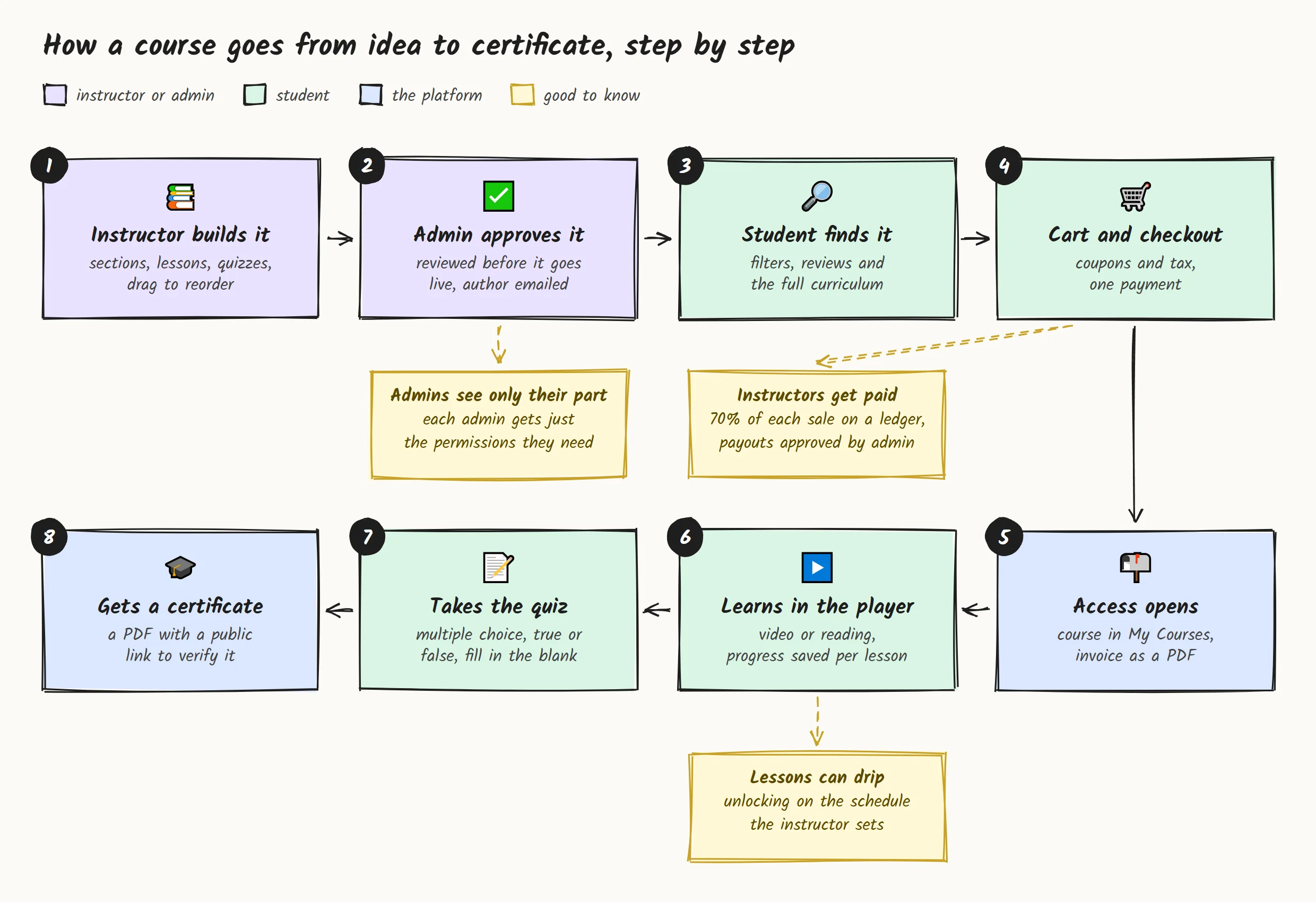
Here's the life of one course, from the instructor building it to a student holding the certificate. The notes show what happens behind the scenes.
The stack
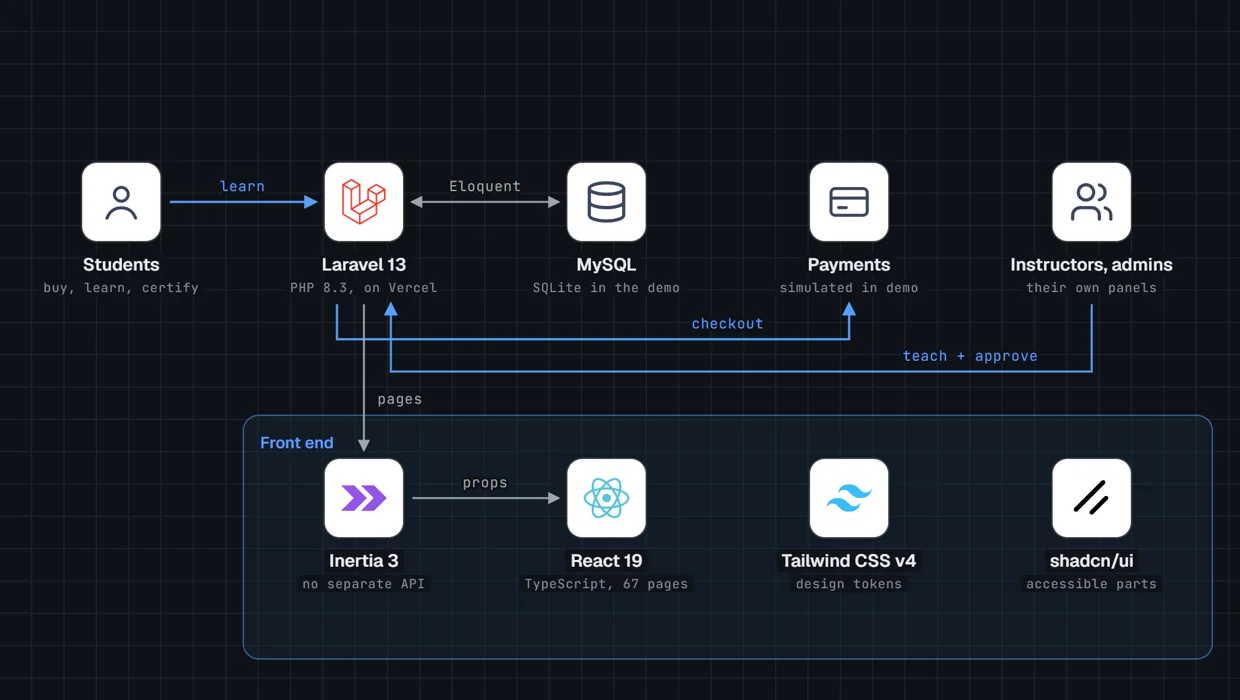
Laravel runs the business rules and the database, and React draws the screens. Inertia joins the two, so there's no separate API to build, version and secure, and a new screen is one controller and one page. Routes are shared with the front end as typed functions, so a renamed link fails the build instead of breaking in front of a student.
The hard parts, and how I solved them
Listing courses is the easy part. The work is in the money, the progress and who is allowed to do what.
-
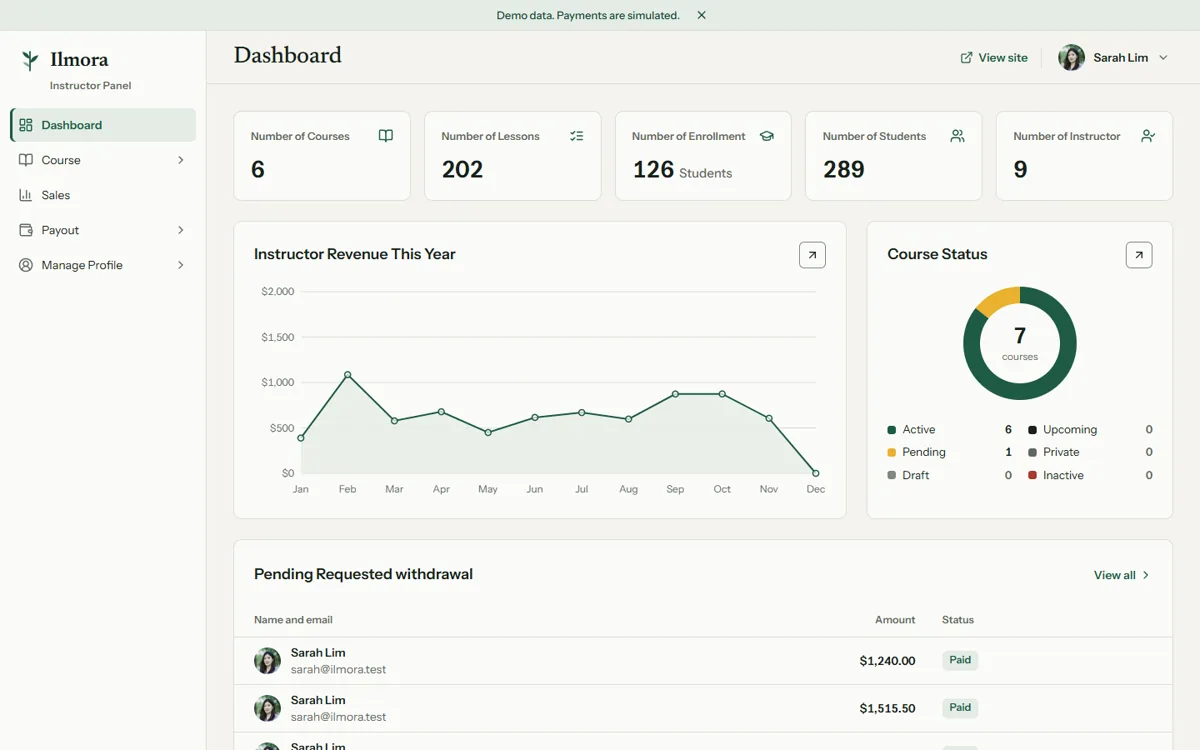
Money that always adds up. Every sale goes through price, coupon and tax, then the instructor's share, 70 percent by default and set by the admin, is written to a ledger line by line. Instructors request a payout from that balance, an admin approves it, and every order has an invoice PDF. When an instructor asks "where's my money?", the answer is one screen away.
-
Progress you can trust. Progress is saved lesson by lesson on the server, not in the browser, so it follows the student to any device. Lessons can unlock on a schedule, and the certificate only appears once every lesson is done, which is what makes the public verification link worth something.
-
Admins who only see their part. Not every admin should touch payouts. There are 17 separate admin permissions plus a super admin, so a support person can manage enrolments without seeing revenue. The demo has a restricted admin account so you can see it for yourself.
-
Courses checked before they go live. A new course waits as pending until an admin approves it, and the author gets an email when it's live. Students can also apply to become instructors by sending their CV as a PDF, and an admin decides.
-
A demo nobody can break. Anyone can log in as an admin, so the demo starts every fresh server from a clean copy of the sample data: 165 users, 40 courses and a year of orders. Whatever a visitor deletes comes back on its own.
How I write the code
-
One job per class. Business rules live in 68 small action classes, like "approve a payout" or "enrol a student", so each rule has one home and is easy to test and change.
-
Checked on the server, every time. Every form is validated by its own request class, and every course, lesson and order is guarded by a policy, so hiding a button is never the only protection.
-
Strict on both sides. PHPStan at level 7 and Pint on the PHP side, strict TypeScript on the React side.
-
Ready for real payment providers. Payment gateways plug in through one registry. In the demo, checkout goes through a simulated gateway where you can pay, fail or cancel and watch what happens to the order.
Delivery
The demo runs on Vercel as a full Laravel app with its own sample data, so you can see every flow from all three sides without signing up. One click on the login page puts you in any role.
You'd get the repo, the database migrations, the sample data that fills a fresh install, and a platform your team can run on any PHP host.
What you get when you work with me
-
The whole product, not one screen. Storefront, checkout, learning, teaching and admin, designed to work together from day one.
-
Money handled carefully. Coupons, tax, revenue splits, payouts and invoices that an accountant can follow.
-
Your secrets stay secret. I work under NDA when you need it, and I'll show future clients a demo like this one, never your product.
-
Code you own. No SaaS LMS subscription, no per student fees. Your repo, your host, your call.
What the client got
3
Panels on one platform: student, instructor and admin
10
Lesson types, from YouTube and Vimeo to PDFs, embeds and quizzes
17
Admin permissions, so each admin sees only their part
Years of
Experience
Projects
Delivered
Features
In Production
Community
Members
Get in touch
Have a product to build, or a workflow that eats your team's time? Tell me about it.I'll build a small working piece of it first, free, so you can judge the result before you commit.